

In a world where compliance work is increasingly automated and commoditized, specialized expertise has become accounting’s unexpected differentiator.
For years, accounting teams competed on some fairly straightforward factors: reputation, relationships, responsiveness, and the simple ability to get work done accurately and on time. But today, another element is rapidly moving to the top of the list: specialized expertise.
As artificial intelligence (AI) automates more and more routine tasks and talent shortages continue to plague the profession, accounting team members who possess high-value skills are becoming increasingly difficult – and expensive – to replace.
Historically, a significant portion of accounting has involved transactional and compliance-related activities. Nothing too crazy: think reconciliations, bookkeeping, tax preparation, audit testing, and routine reporting.
Important stuff? Yes. But AI is handling more and more of those responsibilities faster and more efficiently with each passing year. According to the World Economic Forum’s Future of Jobs Report 2025, analytical thinking, AI literacy, technology skills, and problem-solving capabilities are among the fastest-growing skills across professional industries. That trend is happening in accounting as well. The profession is shifting away from simply producing information and toward helping clients understand what that information means. And this is where specialized accounting expertise becomes incredibly valuable.
While every accounting firm performs some level of compliance work, not everyone possesses expertise in highly specialized areas. Consider the difference between preparing a standard business tax return and advising a client through a multi-state expansion, acquisition, international tax structure, or security assessment. One requires technical competence, the other requires deep expertise. And today’s accounting clients are increasingly recognizing that difference.
According to a recent CPA.com and AICPA Client Advisory Services Benchmark survey, firms reported a median 17% growth rate in Client Advisory Services (CAS) revenue and expect that revenue to nearly double over the next three years, highlighting the growing demand for advisory expertise beyond traditional work.
Some of the most sought-after areas of expertise include:
In a recent Thomson Reuters report, tax, auditing, and accounting respondents who said they were using AI jumped from 8% in 2024 to 21% in 2025. The report found the following usage in specific areas.
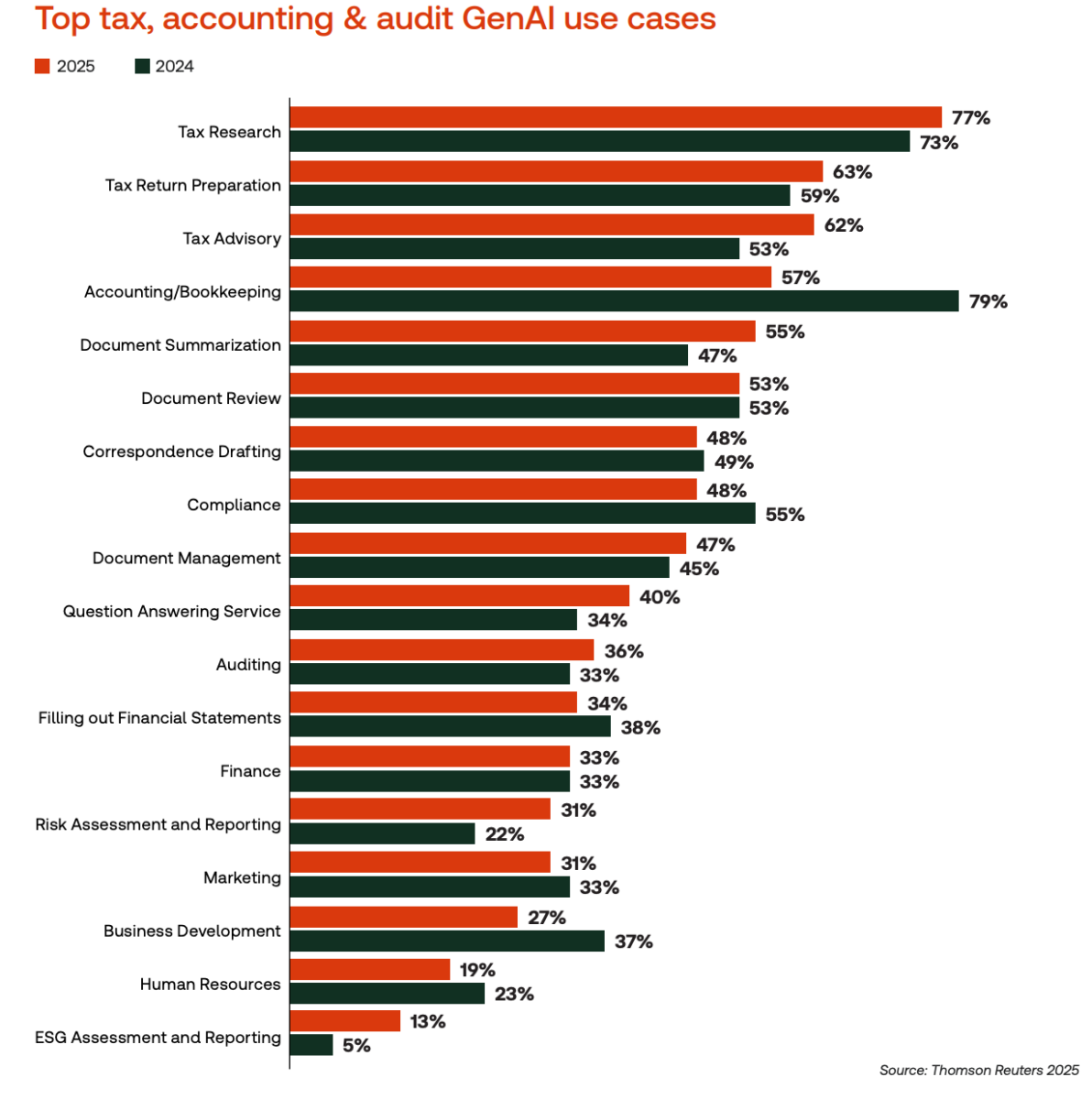
Source: Thomson Reuters, 2025
One of the biggest misconceptions surrounding this AI boom is that it will eliminate the need for accounting professionals. AI can help process information, summarize data, identify patterns, and it’s true that they can execute some decision-making analysis, but people still trust people more. Even if AI can do certain forms of judgmental work, humans are still needed to explain things smoothly to the client, hence the greater priority on client-facing work.
A trickier question is whether new CPAs coming through will have enough experience and institutional knowledge to correct the answers/data from AI. Senior-level CPA talent is still needed for the forseeable future. Thus, as routine work becomes more automated, specialized expertise becomes more valuable, not less.
As mentioned, one area seeing particularly strong growth is advisory services. According to research from CPA.com, firms continue to invest heavily in CAS, viewing advisory work as a significant growth opportunity. Again, clients may use software to generate financial reports, but they still need experienced professionals to answer questions like:
Those conversations require years of experience and judgment, and there is currently no chatbot capable of replacing decades of practical business knowledge. At least not one that can survive a board meeting.
And this is one reason firms are expanding their talent searches beyond traditional geographic boundaries. They’re leveraging remote work, offshore staffing, and global recruiting strategies to access expertise that may not be available locally.
The caveat is, hiring specialized accounting talent locally can be expensive – smaller firms and lean accounting departments often find themselves competing with larger organizations for the same talent pool. Offshore staffing provides an alternative by giving organizations access to highly skilled professionals without the full overhead associated with traditional hiring. Rather than spending months searching for a candidate with experience in areas like international tax, audit procedures, forensic accounting, or advanced bookkeeping, firms can connect with qualified professionals who already possess those skills, often for a fraction of the cost.
Offshore specialists can also help organizations scale more efficiently. Instead of overloading existing employees during busy periods, firms can leverage offshore support to manage recurring tasks, prepare workpapers, assist with reconciliations, or handle other time-intensive responsibilities. This frees up senior staff to focus on higher-value activities such as client relationships, strategic planning, and advisory work.
When used strategically, offshore specialists can help firms increase capacity, improve service levels, and gain access to skills that might otherwise be out of reach, all while allowing their in-house professionals to focus on the work that creates the greatest value.
Before anyone gets concerned by the AI boom, calculators didn’t eliminate accountants, spreadsheet software didn’t eliminate accountants, and AI won’t either. But the firms who thrive in the coming years will be those that invest in specialized expertise, advisory capabilities, and build teams who combine technical excellence with strategic thinking. Because as automation handles more routine work, competitive advantage will increasingly come from what technology cannot easily replicate.
If you’re curious about how offshoring might help your team, reach out to Southwestern Talent. We’re happy to provide a free consultation to answer any questions and offer a complimentary workforce planning session.